Moving to the Netherlands: Verhuiskosten and Gemeente Registration Guide
Published on 20 April 20269 min read
Key takeaways
- You must register at your gemeente within 5 working days of arriving. Registration is free and gives you your BSN.
- Bring proof of address, usually a rental contract in your name. Living with someone or subletting? Then the gemeente asks for a signed statement from the main occupant or owner, with a copy of their ID.
- International moves from Europe typically cost €1,500 to €5,000, and total upfront costs can reach €6,000 to €8,000.
- Moving costs are only reimbursable tax-free through your employer under the 30% ruling. Otherwise they are not tax-deductible.
Table of contents
- What does moving to the Netherlands actually cost?
- Can you claim verhuiskosten back?
- How does gemeente registration actually work?
- Common mistakes when moving to the Netherlands
- FAQ: Frequently asked questions about moving to the Netherlands
- Conclusion: Get your Dutch administration sorted early
- Next steps
You’ve found a flat, signed the contract, and told everyone you’re finally doing it. Then someone mentions you have five working days to complete your gemeente (municipality) registration or you’re technically in breach of Dutch law. And you need a BSN number to open a bank account. And you can’t get a BSN without a registered address. And the gemeente wants proof that you actually live there. Moving to the Netherlands is brilliant, but the admin side of it will test your patience fast.
What is involved in moving to the Netherlands?The important thing to note is that you gotta register at your local gemeente within 5 working days of arriving in the country. They’ll issue your BSN number (Burgerservicenummer) via the BRP register. You’ll need a valid form of ID and a few other bits and bobs like a rental contract in your name as proof of address. Moving costs (verhuiskosten) average €1,500 to €5,000 for European relocations. If you’re moving to the Netherlands for work and your employer is footing the bill for the move then you might be in luck: you may be able to get your moving costs reimbursed tax-free under the 30% ruling.
This guide will cover all the essentials you need to know when moving to the Netherlands in 2026. From what moving expenses to budget for, to step by step municipality (gemeente) registration. We’ll even run through the documents you need to prepare in advance & how to avoid the mistakes that can delay getting your BSN and your first payslip.
What does moving to the Netherlands actually cost?
Moving costs, or verhuiskosten in Dutch, vary enormously depending on where you’re arriving from and what you’re bringing. A local move within the country is a few hundred euros. An intercontinental relocation with a full shipping container is a different story entirely.
Here’s a realistic 2026 cost breakdown:
| Cost item | Typical range |
|---|---|
| Local removal company (studio / 1-bed) | €400 – €900 |
| Local removal company (2+ bedrooms) | €800 – €2,000 |
| International movers (Europe) | €1,500 – €5,000 |
| International movers (USA / Asia) | €4,000 – €12,000 |
| Transport costs (self-drive van hire) | €150 – €600 |
| Housing deposit (1-2 months’ rent) | €1,000 – €3,000 |
| Rent advance (first month) | €800 – €2,500 |
| Utilities connection and setup | €100 – €300 |
| Municipal tax, first year (varies by municipality) | €250 – €600 |
| Gemeente registration | Free |
That deposit line catches people off guard every single time. Dutch landlords routinely ask for one to two months’ rent upfront, on top of your first month’s payment. Come with at least three months’ rent liquid before you sign anything.
Can you claim verhuiskosten back?
Getting moving expenses back depends pretty much entirely on your job situation. If you’re relocating for a new job and your employer is sponsoring the move then that’s where the 30% ruling can come in very useful indeed. Under this scheme, qualifying highly skilled migrants can get tax-free reimbursement for “extraterritorial costs” including relocation costs and moving expenses from the Belastingdienst (that’s the Dutch tax people).
If you’re self-employed or arriving without employer sponsorship, verhuiskosten are not tax-deductible in the Netherlands. There is no private moving expense deduction in the Dutch system. None.
The 30% ruling is governed by Article 31a of the Wet op de loonbelasting 1964. Your application will need to be submitted jointly with your employer to the Belastingdienst. Full eligibility criteria and forms are available on belastingdienst.nl and rvo.nl.
How does gemeente registration actually work?
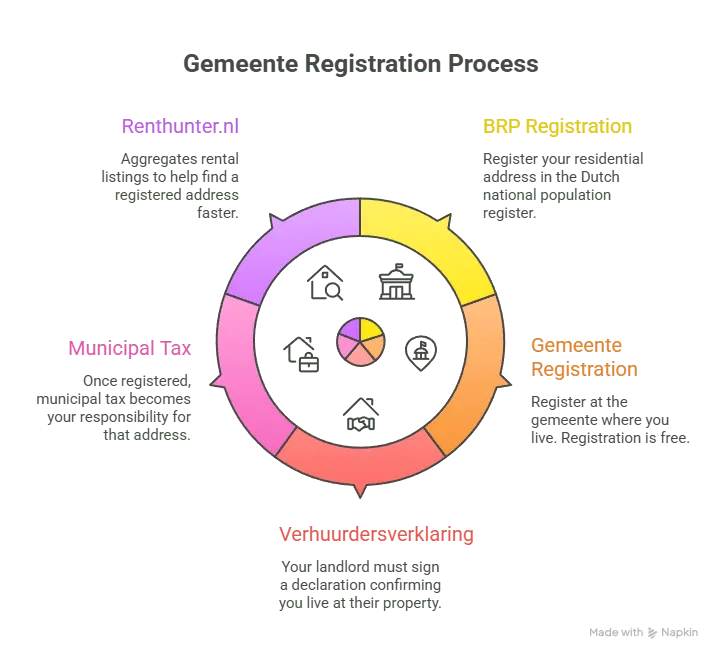
Gemeente registration is the process of entering your residential address into the BRP (Basisregistratie Personen), the Dutch national population register. If you will live in the Netherlands for more than 4 months, you must register at your gemeente. The length of your stay decides, not the type of contract or whether you’re on an exchange programme. Staying less than 4 months? Then you can register as a non-resident in the RNI (Registratie Niet-Ingezetenen) instead, at a gemeente with an RNI desk, and you get a BSN that way too.
You register at the gemeente where you live. In Rotterdam that’s Gemeente Rotterdam. In Amsterdam, Gemeente Amsterdam. Registration is free. The appointment takes 15 to 30 minutes if you have the right documents. Moving to a border town like Venlo and keeping your job in Germany? You register the same way, and our guide to living in Venlo while working in Germany covers the extra cross-border steps: deregistering in Germany, tax and health insurance.
Here’s what most relocation guides miss entirely. You cannot register at a hotel, a hostel, or a temporary address. You need a genuine residential address, and the gemeente asks for proof that you live there (bewijs van bewoning). Usually that’s a rental contract in your name. Contract not in your name, because you live with someone or sublet? Then you need a signed statement of permission from the main occupant or the owner, with a copy of their ID. What each gemeente accepts varies: Den Haag, for example, also wants a copy of a private landlord’s ID. Check your gemeente’s list, and have those papers in your hands before you book the appointment. Not the day after.
Once registered, municipal tax (gemeentelijke belastingen) becomes your responsibility for that address, covering waste collection, water board levies, and local services. That bill arrives automatically. No action required on your end, but budget for it.
If you’re still searching for an apartment, Renthunter.nl aggregates listings from multiple Dutch rental platforms into one overview, which makes finding a registered address significantly faster when you’re searching from abroad and working against a registration deadline.
Documents you need for gemeente registration
- Valid passport or EU identity card (not expired)
- Signed rental contract in your name, used as proof of address
- Contract not in your name? A signed statement of permission from the main occupant or owner, plus a copy of their ID
- For non-EU citizens: valid residence permit (verblijfsvergunning) or entry visa (MVV)
- Birth certificate (requested by some municipalities, not all)
- Marriage or civil partnership certificate if registering a partner at the same address
Proof of address is the document that delays the most people. Chase it down before you travel.
Common mistakes when moving to the Netherlands
- Missing the 5-day registration window. You must register at the gemeente within 5 working days of establishing residency. Settling in first is not a valid reason for delay. The clock starts on moving day.
- Arriving without proof of address. Bring a rental contract in your name. Not on the contract yourself? Then the main occupant or owner signs a statement of permission and gives you a copy of their ID. Sort it before you board the plane.
- Assuming HR will handle the registration. Some relocation packages include admin support, but gemeente registration and BRP address registration are your personal legal obligation, not your employer’s responsibility.
- Paying moving costs before confirming 30% ruling eligibility. If you qualify and your employer reimburses verhuiskosten without the ruling active, you lose the tax-free benefit permanently for that payment. There is no appeal.
- Underestimating upfront rental costs. Deposit plus rent advance plus moving expenses plus utilities setup can easily reach €6,000 to €8,000 before your first Dutch payslip arrives. Budget for it properly and don’t arrive underfunded.
Free calculator
Moving to the Netherlands Cost Calculator: Your 2026 Budget Guide
Try it right here. No sign up, 30 seconds.
FAQ: Frequently asked questions about moving to the Netherlands
What are the moving costs to the Netherlands from Europe?
Moving costs from Europe typically range from €1,500 to €5,000, depending on home size, distance, and whether you choose full-service removals or a self-drive van.
What is the cost of moving to the Netherlands including deposit and first rent?
Budget between €3,500 and €7,000 upfront to cover international removal fees, a housing deposit (1-2 months’ rent), your first month’s rent advance, and utility setup.
What are the relocation costs for moving to the Netherlands as an expat?
Total relocation costs usually fall between €4,000 and €10,000, covering removals and housing, though employer reimbursement under the 30% ruling often offsets a significant portion tax-free.
How does registration at the gemeente in the Netherlands work?
Book an appointment at your local municipality, attend in person with your passport and rental contract, and complete your BRP address registration to receive a BSN.
How do I complete BSN registration at the gemeente?
BSN registration is the automatic result of your BRP address registration, where the number is assigned on the spot or sent via letter within five working days.
How do I register at the gemeente in the Netherlands step by step?
Book an online appointment, gather your passport and signed rental contract, attend the meeting in person, and receive your BSN confirmation once your details are processed.
How do I calculate verhuiskosten online before my move?
Calculate verhuiskosten by requesting quotes from three removal firms and adding your expected housing deposit, first month’s rent advance, and utility connection fees for a total.
What documents are needed for gemeente registration in the Netherlands?
Registration requires a valid passport, proof of address (usually a signed rental contract in your name, or a signed statement of permission from the main occupant with a copy of their ID), and a residence permit for non-EU citizens. Each gemeente publishes its own list, so check yours.
Conclusion: Get your Dutch administration sorted early
Amsterdam, Rotterdam, Den Haag & Utrecht: wherever you’re headed the process is basically the same. Secure a registered address, book an appointment with the municipality before you get here, bring your proof of address and you should be getting your BSN number within 5 working days. Everything else should fall into place after that. Moving to the Netherlands rewards the people who do the admin right. Don’t be the one who turns up unprepared.
Next steps
- Find your Dutch rental: Search rentals on Renthunter.nl. Browse verified listings from multiple platforms in one place to find your registered address before the gemeente appointment
- Know your tenant rights: Tenant rights in the Netherlands explained (2026). What Dutch law protects you on from day one of your rental contract
- Decode your rental contract: Dutch rental contract explained for expats key clauses, red flags, and what to check before signing
- Set your housing budget: Average rent in the Netherlands by city (2026). Real city-by-city figures so you know what to budget before you start searching
Free alert
Know what your move really costs before you sign: deposit, first rent, transport and fees in one calculator.

Ready to find your perfect home?
Join thousands of expats, students, and professionals who found their home with RentHunter.