Who Can Register at Your Address in the Netherlands and Under What Conditions? (Updated 2026)
Published on 11 May 202610 min read

Key takeaways
- Anyone who genuinely lives at your address can register there. Registering someone who does not is technically fraud.
- Registration depends on where someone actually lives, not on your landlord’s consent. If you rent, your lease may still require your landlord’s written OK for an extra occupant.
- In Amsterdam, the gemeente asks for a toestemmingsverklaring (consent statement) signed by the owner or by the resident registered at the address longest, often you as the tenant.
- You must be in the BRP if you live here more than four months, and your BSN depends on it.
Table of contents
- Who can register and under what conditions?
- What is BRP registration and why does it matter so much?
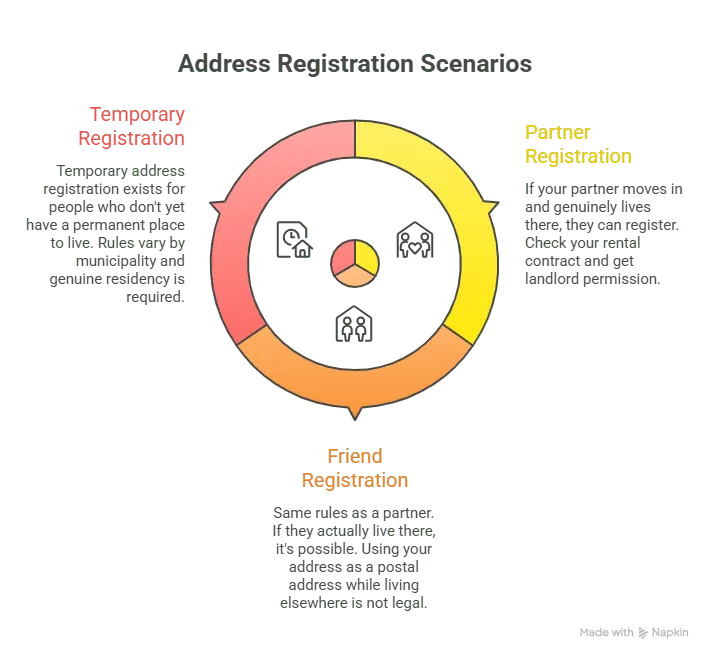
- If your partner wants to register at your address
- If a friend wants to register at your address
- If someone needs temporary registration
- What your landlord’s permission is for
- Risks to know about as the main tenant
- Checklist before allowing someone to register
- Does the process differ by city?
- Common mistakes
- Your situation at a glance
- What to do next
Your partner just arrived. Or a friend needs to get their official paperwork sorted somewhere. Or someone staying with you has asked about registering there, and now you’re not sure if it’s even allowed, who needs to sign off on it, or what you’re actually responsible for if things go sideways.
These questions come up constantly. The answers matter because getting address registration wrong can cause real problems. Here’s how it actually works.
Anyone who genuinely lives at your address can legally register there. The key word is “genuinely”: registration must reflect actual residency, not just where it’s convenient for someone to be registered. In rental situations your lease may require your landlord’s written permission for an extra occupant, but the registration itself does not depend on it. In Amsterdam there’s a specific consent form, which you as the tenant can usually sign yourself. Partners, friends, and family members can all register under the right conditions.
Who can register and under what conditions?
| Who wants to register | Can they? | Key condition | Extra steps |
|---|---|---|---|
| Partner moving in | Yes | Must actually live there | Check your lease on extra occupants; toestemmingsverklaring in Amsterdam |
| Friend who genuinely lives there | Yes | Must actually live there, not just use address | Check your lease on extra occupants |
| Family member who moves in | Yes | Must actually live there | Check your lease on extra occupants |
| Temporary resident (short stay) | Sometimes | Must actually stay there, not permanent address elsewhere | Check with your specific gemeente |
| Someone subletting a room from you | Yes | Must actually live there | Your lease must permit subletting (landlord permission for the sublet, not for the registration) |
| Someone who doesn’t actually live there | No | Registration must reflect real residency | Doing this is technically fraud |
The consistent thread through all of these: registration reflects where someone actually lives. The municipality doesn’t care about the relationship. They care about the physical reality of who is residing at that address.
What is BRP registration and why does it matter so much?
BRP is short for Basisregistratie Personen, which is essentially the Dutch population register. If you’re living in the Netherlands for more than four months, you’re required to be in it. Your registered address is what the Dutch government treats as your actual address, full stop.
Your BSN number is tied to your BRP registration. And your BSN is tied to basically everything: your bank account, health insurance, employment contracts, tax returns, student finance. Without a registered address, none of that works properly. That’s why people ask about registering at someone else’s address. They need it for practical reasons, not bureaucratic ones.
If your partner wants to register at your address
This is the most common scenario and generally the most straightforward. If your partner moves in with you and genuinely lives there, they can register.
What you need to do:
- Check your rental contract to confirm that an additional occupant is permitted
- If your lease requires it, get written permission for an extra occupant from your landlord or housing corporation (this is about your lease, not the registration)
- In Amsterdam, fill in the toestemmingsverklaring: the owner or the resident registered at the address longest (usually you) signs it and adds a copy of their ID
- Your partner books an appointment at the gemeente (municipality) online
- They attend with valid ID and proof of address (usually a copy of the lease, plus the signed consent form where the gemeente asks for one)
- The municipality processes the registration
In Amsterdam specifically, the gemeente asks for the toestemmingsverklaring when someone registers at an address where others are already registered. Sign it before making the appointment. If nobody will sign, that alone is not a legal reason to refuse the registration: the gemeente looks at where the person actually lives (answers to parliamentary questions 2019Z16147).
If a friend wants to register at your address
Same rules as a partner. If they actually live there, it’s possible. If they just want to use your address as a registration address while living somewhere else, that’s not legal and can cause problems for you.
The practical question to ask yourself: does this person genuinely reside at my address? Sleeping there most nights, having their belongings there, this being their actual home? Then registration is legitimate and possible. Using your address as a postal address while living elsewhere is a different situation and the municipality treats it as such.
Your lease applies here too: if it limits occupants, your landlord’s OK matters for your tenancy. Some landlords are fine with it, some aren’t. Check your lease and ask before you say yes to anyone.
If someone needs temporary registration
Temporary address registration exists in the Netherlands for people who don’t yet have a permanent place to live. The rules vary by municipality and the situation needs to reflect genuine residency.
Some municipalities allow temporary registration at a family member or friend’s address. Others have specific requirements. Contact your local gemeente directly for the rules that apply to your specific city and situation. The national BRP rules are the same everywhere but municipalities have some discretion in how they process temporary registrations.
What your landlord’s permission is for
If you’re renting, confirming your landlord’s permission in writing before someone moves in is important. Not for the BRP: registration depends only on where someone actually lives, not on anyone’s consent, as the government told parliament in October 2019 (answers to parliamentary questions 2019Z16147; Wet BRP). The permission matters for your lease. Here’s why:
Having an additional person live at a rented property without the landlord’s knowledge can violate your lease. In social housing, it can be treated more seriously and potentially as fraud. Many leases require the landlord to agree to additional occupants. Some rental contracts explicitly limit the number of residents.
In Amsterdam, the gemeente asks for a toestemmingsverklaring (“Toestemming inschrijving op adres”) when someone registers at an address where others already live. The owner or the resident registered there longest signs it and adds a copy of their ID, so as the main tenant you can usually sign it yourself (gemeente Amsterdam). Den Haag asks for a similar toestemmingsformulier from the main resident or owner (gemeente Den Haag). A gemeente may ask for this form or other proof of residence, but consent is not a legal condition for registration. If nobody will sign, tell the gemeente, hand in what proof you have that the person lives there and ask for an address check (adresonderzoek). The gemeente establishes where the person actually lives and can correct the register on its own initiative (“ambtshalve”), as the 2019 answers to parliament explain.
This is about other people registering at your address. Registering yourself at the home you rent is a different case, and your own legal duty: see can your landlord stop your BRP registration?
Risks to know about as the main tenant
Saying yes to someone registering at your address is not a formality. There are a few things worth understanding before you agree.
If your rental contract has restrictions on additional occupants and someone gets registered without your landlord knowing, that can be grounds for a lease dispute. If the person being registered has significant debts, their registered address can show up in official processes. That doesn’t mean your belongings are at risk, but it can create bureaucratic headaches you didn’t ask for. In some social housing situations, the number of registered residents also affects rent calculations or housing benefit amounts.
None of this means you can’t do it or shouldn’t. It just means checking your lease first and, if it asks for it, getting your landlord’s OK in writing before the person moves in.
Checklist before allowing someone to register
Go through this before saying yes to anyone:
- Read your rental contract for anything about occupants or subletting
- If your lease requires it, get your landlord’s or housing corporation’s written OK for an extra occupant
- If in Amsterdam, sign the toestemmingsverklaring (or have the owner sign it) before the person gives their move to the gemeente
- Confirm the person genuinely lives at your address, not just uses it for registration
- Check whether your housing benefit or rent allowance changes with an additional registered resident
- Make sure you both understand that when they leave, they need to update their own registration
Does the process differ by city?
Yes, somewhat. The BRP is national but municipalities have some local discretion.
| City | Notable specifics |
|---|---|
| Amsterdam | Toestemmingsverklaring signed by the owner or the resident registered longest, plus a copy of their ID |
| Rotterdam | Verklaring van inwoning when others are already registered at the address |
| Den Haag | Toestemmingsformulier from the main resident or owner, plus a copy of their ID |
| Utrecht | Standard process, appointment at gemeente required |
| Other cities | Generally follow national BRP rules |
Amsterdam’s toestemmingsverklaring is the most commonly asked about. It’s a direct response to the city’s housing shortage and the historical problem of address fraud. The form is signed by the property owner or by the resident registered there longest, and sent with the move: online, by post or at the Stadsloket.
Common mistakes
Registering someone who doesn’t actually live there.
This is technically fraud. The BRP is supposed to reflect actual residency and doing this as a favour can create serious problems for both parties if it comes to light.
Not checking your lease first.
If you’re renting, your lease may require your landlord’s OK before someone moves in. That OK is about your tenancy, not the BRP, so get it in writing before the person moves in, not after.
Registering someone in Amsterdam without the toestemmingsverklaring.
The gemeente asks for it, and without it expect questions or a check of where the person lives. Sign the form before you book the slot, not the other way around.
Not deregistering when someone moves out.
Updating the registration when they leave is their responsibility, not yours. But if they don’t do it, they stay officially linked to your address and that can cause complications down the line. If someone moves out and doesn’t deregister, you can contact the municipality yourself to report that they no longer live there.
Your situation at a glance
| Your situation | What you need |
|---|---|
| Partner moving in, you’re renting | Check your lease on extra occupants. Toestemmingsverklaring if in Amsterdam. |
| Friend genuinely living with you | Same as above. Confirm they actually reside there, not just using the address. |
| Short-term guest, not actually living there | Registration is not appropriate. This reflects real residency, not convenience. |
| You’re in Amsterdam | The gemeente asks for a toestemmingsverklaring, signed by the owner or the resident registered longest. |
| Someone moves out but doesn’t deregister | Their responsibility to update. If they don’t, you can report to the municipality that they no longer live there. |
| Your housing benefit might be affected | Check before registering. Household composition can change rent allowance calculations. |
What to do next
If someone needs to register at your address: check your lease (and get your landlord’s OK in writing if it asks for one), sign the toestemmingsverklaring if you’re in Amsterdam, and make sure the person actually books their gemeente appointment.
And if you’re still looking for a rental in the Netherlands where you can register properly, that’s where the search starts. Confirming BRP registration is possible should be one of the first questions you ask before signing any lease.
Renthunter monitors over a thousand rental sources across the Netherlands. Search by city and find a rental that actually works for your situation.
Free alert
Before your partner or friend registers, check your lease, what the gemeente asks for and your risks as main tenant.


Ready to find your perfect home?
Join thousands of expats, students, and professionals who found their home with RentHunter.